


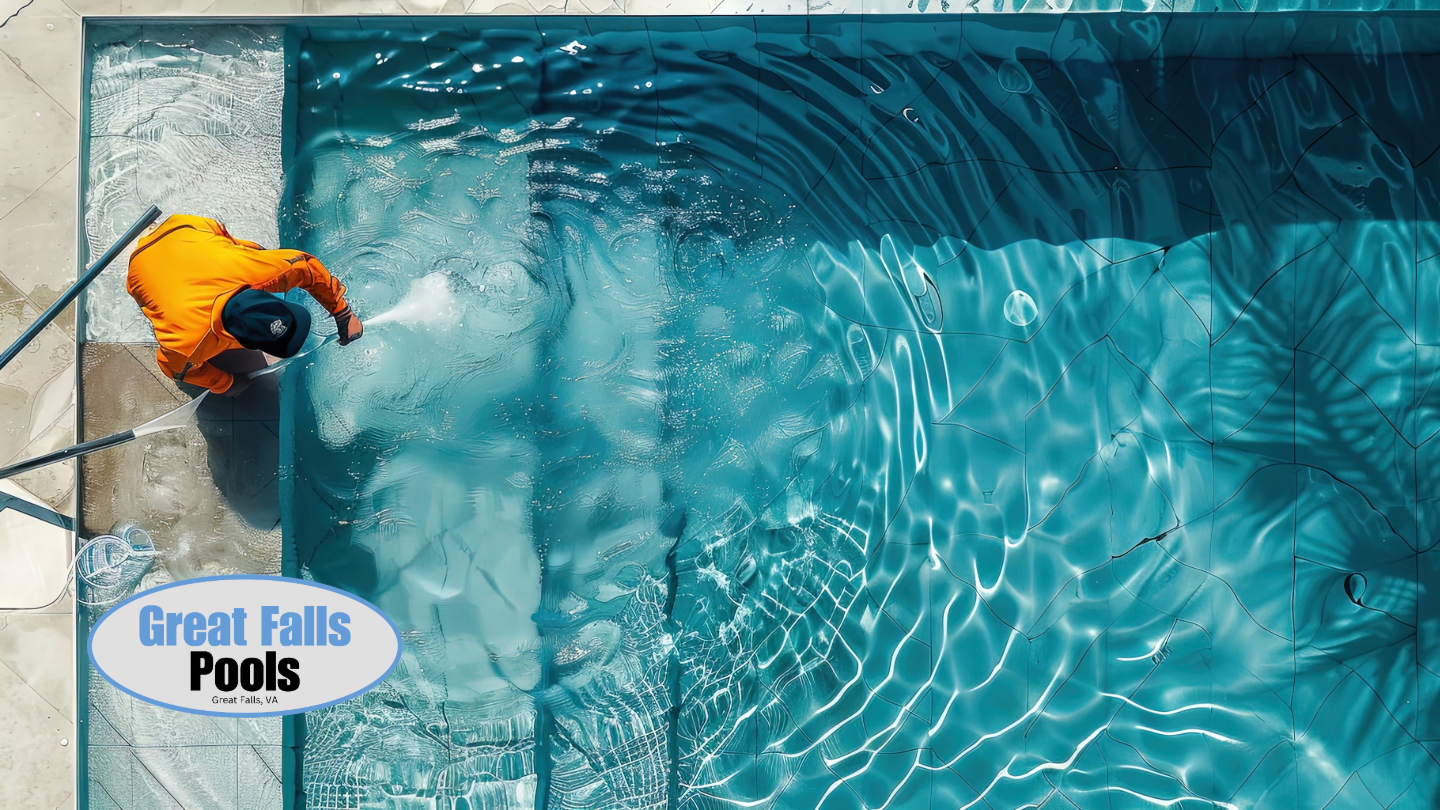
Noticed strange stains on your pool walls or floor? You’re not alone. If you’re wondering how to remove pool stains, Great Falls Pools has your back. Good news: most pool stains can be cleaned up without ever draining your water.
Here’s everything you need to know to identify and eliminate those annoying stains and keep your pool looking spotless.
Why Do Pool Stains Happen?
Stains form when minerals, metals, or organic materials react with your pool’s water. Here are the usual suspects:
- Metal stains: These show up as rusty brown, black, or green spots. Iron, copper, and manganese are the most common culprits.
- Organic stains: Think brown or green smudges from leaves, algae, or natural debris.
- Mineral scale stains: These look like chalky white or gray deposits from high calcium or pH levels.
Identifying the type of stain is key to choosing the right removal method.
“Pool owners commonly mistake stains or water discoloration for pool algae. However, unlike algae, pool stains do not brush off readily and are not slick or slimy.” – Clorox
What You’ll Need
Before you start, grab these tools:
- Pool brush (nylon or stainless, depending on your pool type)
- Ascorbic acid (yes, Vitamin C works wonders on metal stains)
- Pool stain remover made for your stain type
- Water test kit for pH, alkalinity, and chlorine
- Optional: pumice stone for extra-stubborn spots
How to Remove Pool Stains Without Draining
Follow these steps for safe, effective stain removal:
1. Test Your Water
Check pH and chlorine levels first. If pH is too high, stains cling harder. Aim for a pH between 7.2 and 7.4.
2. Do a Spot Test
Sprinkle a little ascorbic acid on a stain. If it fades quickly, it’s likely a metal stain. That’s your green light to treat the whole area.
3. Treat the Stains
Apply ascorbic acid across the stained area. Let it sit 30 to 60 minutes, then brush lightly. Your pool filter will take care of the rest.
4. Rebalance Your Chemistry
After treatment, retest your pool. Make sure your pH and alkalinity are back in balance. Recommended levels:
- pH: 7.4 to 7.6
- Alkalinity: 100 to 150 ppm
5. Use a Stain-Specific Remover
Still see stains? Use a targeted remover. Enzyme-based products work well for organic stains, while scale needs a gentle acidic solution designed for pools.
How to Prevent Pool Stains
Keep your pool stain-free with these simple habits:
- Brush and vacuum regularly
- Keep your water balanced
- Use a sequestrant if your water has metals
- Check for rust or corrosion on your equipment
- Get regular service checks from a pro
Need Help? We’ve Got You Covered
Stubborn stain that just won’t quit? Don’t let it ruin your swim season. Reach out to Great Falls Pools for expert advice and professional treatment. Visit our contact page to get started.
We proudly serve Northern Virginia, including Fairfax County (Great Falls, McLean, Vienna, Oakton, Fairfax, Falls Church, Annandale, Burke, Springfield, and Reston), eastern Loudoun County, Arlington, and the City of Falls Church. We also service Northwest Washington, D.C., including Georgetown, Spring Valley, and Palisades, as well as Potomac, Maryland.
Remember: Whether it’s rust spots, leaf stains, or mystery marks, knowing how to remove pool stains can save your water, your time, and your pool’s good looks.